


Medical Spa Services Explained: What to Expect


Most people assume a medical spa is just a fancier day spa with better lighting. That assumption leads to confusion, missed expectations, and sometimes real disappointment. Medical spas, formally called medispas or med spas, are a distinct category of aesthetic practice. According to the American Med Spa Association, they combine non-invasive aesthetic treatments with licensed healthcare oversight, specifically because these services affect living tissue beneath the skin surface. Understanding what services medical spas offer explained through clear categories is exactly what this guide does, so you can walk into your first consultation knowing what to ask and what to expect.
Table of Contents
Key takeaways
Point | Details |
Med spas differ from day spas | Services involve licensed medical supervision and affect living tissue, not just surface skin care. |
Five main service categories | Injectables, energy and light therapy, body contouring, skin resurfacing, and specialty treatments cover most med spa menus. |
Botox and fillers treat different problems | Botox addresses movement-caused wrinkles; fillers restore volume and structural contour. |
Sessions vary by treatment | Some services require one visit; others follow multi-session protocols with maintenance schedules. |
Provider credentials matter | Verifying licensing, supervision models, and experience before booking protects your safety and results. |
What services medical spas offer explained
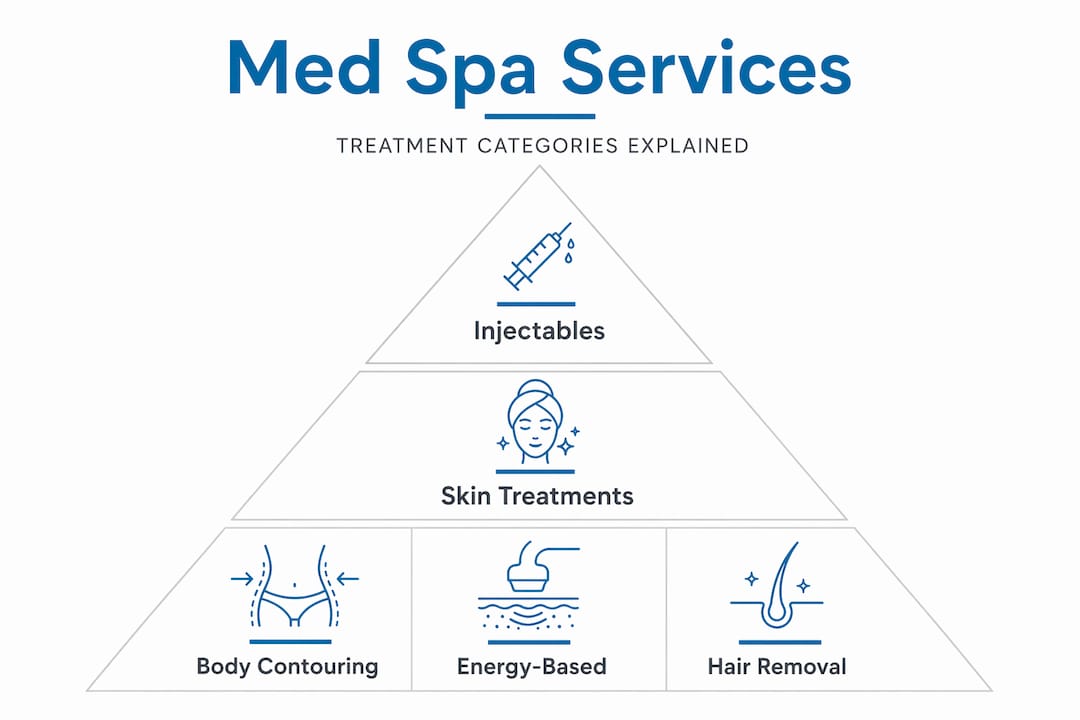
The American Med Spa Association’s treatment directory classifies services into five core categories: Injectables, Energy and Light, Body Contouring, Skin and Surface, and Specialty treatments. Understanding this framework helps you decode any med spa’s service menu.
Here is a quick overview of what falls into each category:
Injectables: Botox (neuromodulators), dermal fillers, PRP/PRF injections
Energy and light therapies: Laser hair removal, Intense Pulsed Light (IPL), Broadband Light (BBL), radiofrequency skin tightening
Body contouring: CoolSculpting, non-invasive fat reduction, muscle stimulation devices
Skin and surface treatments: Microneedling, chemical peels, microdermabrasion, BB Glow
Specialty treatments: Thread lifts, IV therapy, paramedical tattooing, customized facial protocols
Pro Tip: Ask any med spa you consider whether their service menu distinguishes clinical protocols from cosmetic add-ons. Menus that blur these lines can signal a provider more focused on upselling than on medical integrity.
For perspective on what non-surgical skin treatments can realistically achieve, the range is genuinely wide, covering everything from fine line reduction to body shape refinement, all without general anesthesia or surgical recovery.
Service category | Common examples | Typical goal |
Injectables | Botox, fillers, PRP | Wrinkle reduction, volume restoration |
Energy and light | Laser, IPL, BBL | Hair removal, tone correction, rejuvenation |
Body contouring | CoolSculpting | Non-invasive fat reduction |
Skin and surface | Microneedling, chemical peels | Texture, tone, resurfacing |
Specialty | Thread lifts, IV therapy | Structural lifting, systemic wellness |
How injectables work and what they treat
Injectables are the most requested services at nearly every med spa, and also the most misunderstood. Two treatments dominate this category, and they are not interchangeable.

Botox is a neuromodulator. It relaxes the muscles that cause dynamic wrinkles, which are the lines that form when you squint, raise your brows, or smile repeatedly over years. It does not add volume. It does not change your face shape. It simply interrupts the muscle movement that deepens those lines.
Dermal fillers work on a completely different principle. They physically restore lost volume in areas where fat pads have thinned or bone density has shifted with age. Think hollowed cheeks, flattened lips, or a softening jawline. Fillers address structure; Botox addresses movement. Knowing this distinction before you consult prevents the frustration of expecting the wrong result from either product.
Here is what a typical injectable consultation and appointment involves:
Initial consultation: Your provider assesses your concerns, reviews your health history, and discusses realistic outcomes. This is where goals are aligned with biology.
Treatment planning: Your injector identifies which product fits your concern, how many units or syringes are appropriate, and where to place them.
The injection: Most sessions take 15 to 45 minutes depending on the number of areas treated. Topical numbing is often available.
Recovery: Botox has virtually no downtime. Fillers may cause mild swelling or bruising for a few days, but most people return to normal activities immediately.
Follow-up: Results from Botox appear within 3 to 7 days and last 3 to 4 months. Filler results are immediate and can last 6 to 18 months depending on the product.
On cost, Botox is priced per unit, while dermal fillers run $500 to $1,200 or more per syringe. These are not one-time purchases if you want to maintain results.
Safety is non-negotiable in this category. Not all fillers on the market carry FDA approval, and complications from unqualified injectors can be serious and difficult to reverse. Choose providers who can clearly explain the products they use and who have a supervising physician in the model.
Pro Tip: If a clinic cannot tell you the brand name of the filler they plan to inject and whether it is FDA-approved, that is a clear reason to walk away.
Energy-based treatments and body contouring
Energy-based treatments are the second major pillar of medical spa services and also the category most likely to be oversold with unrealistic timelines. The mechanism here is biological remodeling, which means results develop over weeks or months as your body responds to the treatment, not the moment you walk out the door.
Energy-based treatments affect living tissue and require medical judgment about contraindications, skin type, and health history. A provider who skips this assessment is cutting corners that matter.
The most common options in this category include:
Laser hair removal: Uses targeted light energy to destroy hair follicles. Requires multiple sessions (typically 6 to 8) because hair grows in cycles. Results are long-term but not always permanent.
IPL and BBL treatments: Broadband light addresses sun damage, redness, uneven tone, and early signs of aging. These are not the same as laser resurfacing but work well for maintenance and tone correction.
Radiofrequency and ultrasound devices: Stimulate collagen by delivering controlled heat to the dermis. Used for mild skin tightening, particularly around the neck and jawline.
Laser skin resurfacing: More aggressive than BBL, this targets deeper texture irregularities, fine lines, and acne scars. Recovery time increases with intensity.
Body contouring, specifically CoolSculpting, uses controlled cooling to destroy fat cells in targeted areas. It is not a weight loss tool. It is a shaping tool for people close to their goal weight who have stubborn fat deposits unresponsive to diet and exercise. Results appear gradually over 2 to 3 months as the body eliminates the treated cells.
Treatment | Mechanism | Sessions needed | Timeline for results |
Laser hair removal | Light destroys follicles | 6 to 8 | Visible after 2 to 3 sessions |
IPL/BBL | Light targets pigment and vessels | 1 to 3 | 2 to 4 weeks per session |
CoolSculpting | Controlled fat freezing | 1 to 2 per area | 8 to 12 weeks |
RF skin tightening | Heat stimulates collagen | 3 to 6 | 3 to 6 months |
Understanding skin rejuvenation procedures before booking removes the guesswork and sets you up for realistic satisfaction rather than disappointment.
Reading a med spa menu and booking smart
Med spa service menus can look deceptively simple. A list of treatment names with prices tells you almost nothing about whether a service fits your specific concern, how many sessions you actually need, or what the full cost commitment looks like over time.
Service menus often blur the line between single-appointment treatments and multi-session clinical protocols. Botox is one appointment every few months. A chemical peel series might run 4 to 6 sessions. IV therapy is typically offered on a subscription or recurring basis. Knowing this before you book changes how you budget and plan.
Here are the questions worth asking before you commit to any treatment:
How many sessions does this require for the result shown in your photos? Promotional images often reflect full treatment courses, not one visit.
Who performs this specific treatment? A registered nurse, nurse practitioner, physician assistant, or physician each carries different training. Know who is touching you.
What is the supervision model? A licensed physician should be part of the oversight structure even if they are not in the room.
What are the contraindications? Pregnancy, certain medications, and specific skin conditions can disqualify you from some treatments. A provider who does not ask is a provider who is not protecting you.
What does maintenance look like? Some treatments require touch-ups every 3 months; others hold well for a year. Budget accordingly.
The verification step before booking matters more than most people realize. Checking a provider’s credentials, understanding who supervises their practice, and confirming what products they use takes ten minutes and can prevent serious complications.
Red flags to watch for include providers who minimize risks, quote unusually low prices for injectables without specifying units or syringe counts, or decline to discuss credentials openly. Reputable med spas welcome these questions.
Pro Tip: Request a consultation before committing to any package. A legitimate med spa will always offer this step, and it is your best opportunity to assess whether the provider’s approach aligns with your goals and comfort level.
For a thorough breakdown of what to check before your visit, Luxveritae’s med spa safety checklist covers the full evaluation process in practical detail.
My honest take on navigating med spa choices
I have seen what happens when people arrive at a consultation with a treatment in mind rather than a concern in mind. They ask for the filler they saw on social media instead of describing the hollowness in their mid-face. They book laser resurfacing without mentioning the retinoid they have been using for six months. The mismatch between expectation and outcome is almost always a communication failure, not a clinical one.
What I have learned from working with clients across a wide range of aesthetic goals is that the best results come from providers who slow you down in the consultation rather than rush you into a booking. The question “what concerns you most about your skin right now?” reveals infinitely more than a menu selection does.
Medical supervision is not a bureaucratic checkbox. It is the structure that allows a practice to course-correct when a patient’s response to treatment is unexpected. I have seen firsthand how the absence of proper oversight turns manageable situations into complicated ones.
My advice: choose providers who ask more questions than you do, who explain their reasoning, and who are willing to tell you when a treatment is not the right fit. That honesty is the clearest signal you are in a skilled and ethical practice.
— Lux
Explore personalized treatments at Luxveritae
At Luxveritae, every treatment begins with understanding your skin, your goals, and your lifestyle. The services align directly with the categories covered here, from advanced skin resurfacing and BB Glow to specialty paramedical techniques designed to blend naturally with your features.
Luxveritae’s approach prioritizes personalized consultation and certified expertise over one-size-fits-all packages. Whether you are exploring a single treatment or building a multi-session skin health plan, the team will help you identify what fits. Browse the full range of available treatment packages to see current offerings, pricing, and combination options. When you are ready to take the next step, book your consultation online and start with a conversation rather than a commitment.
FAQ
What is the difference between a spa and a medical spa?
A traditional day spa offers surface-level treatments like massages and basic facials that do not affect living tissue. A medical spa performs treatments that go beneath the skin surface and require licensed healthcare professional oversight.
Are medical spa treatments safe?
Most medical spa treatments are very safe when performed by qualified, licensed providers under proper medical supervision. Safety requires confirming provider credentials, the supervision model, and the regulatory status of any products used.
How many sessions do medical spa treatments usually take?
It depends entirely on the treatment type. Injectables like Botox are single appointments with repeat visits every 3 to 4 months, while protocols like laser hair removal or chemical peel series typically require 4 to 8 sessions for full results.
What should I ask during a medical spa consultation?
Ask who performs the treatment, their credentials, the medical supervision model, how many sessions your specific goal requires, and what the maintenance schedule looks like. Providers who answer these questions clearly and thoroughly are the ones worth trusting.
Do I need a referral to visit a medical spa?
No referral is needed. You can book a consultation directly, and the initial appointment is typically where your provider assesses your suitability for specific treatments and builds a personalized plan based on your skin type, health history, and aesthetic goals.
Recommended
Comments