


Med spa safety standards: What you need to know


Walking into a medical spa for a “simple” skin treatment feels routine, but the safety standards governing that appointment can vary more than most clients ever realize. Many people assume that because a procedure is non-surgical or non-invasive, the risks are minimal and the oversight is consistent. That assumption can be costly. From regulatory gaps to undertrained staff operating advanced devices, the landscape of medical spa safety is more complex than the polished reception area suggests. This guide breaks down exactly how safety standards work, who is responsible for enforcing them, and what you should look for before booking any aesthetic treatment.
Table of Contents
Device risks and safeguards: What you need to know about energy-based treatments
Facility safety: Infection control, emergency plans, and compliance essentials
A fresh perspective: Why consistent enforcement and patient vigilance matter most
Explore safe, effective medical spa treatments with confidence
Key Takeaways
Point | Details |
Varying standards | Not all med spas are subject to the same safety rules due to differences in state regulations. |
Physician oversight | Safe practices require physician involvement and proper staff training for every medical procedure. |
Device precautions | Energy-based treatments have specific risks and demands for equipment maintenance and clinician skill. |
Facility protocols | Cleanliness, emergency plans, and regulatory compliance protect you at the facility level. |
Patient vigilance | You can reduce your risk by proactively asking about safety, staff credentials, and written policies before treatment. |
Why safety standards matter for medical spa treatments
Medical spas occupy a unique space between traditional day spas and clinical medical offices. That middle ground creates real ambiguity around who sets the rules, who enforces them, and what protections you can count on as a client.
The foundation of medical spa regulation sits at the state level, and state-level rules vary significantly for ownership requirements and for who can legally perform procedures, especially when non-physician providers are involved. This means a treatment that requires physician oversight in one state may be legally performed by an esthetician in another. The result is a patchwork of protections that can leave clients unknowingly exposed.
Why does this matter in practice? Consider these common risks when safety standards are inconsistent or poorly enforced:
Burns and scarring from improperly calibrated energy-based devices
Infections resulting from inadequate sterilization or single-use equipment protocols
Allergic reactions or complications from products applied without a proper medical history review
Delayed emergency response when no trained medical professional is on site
Incorrect treatment selection when providers lack the clinical background to assess skin conditions
“Safety standards are not a formality. They are the difference between a treatment that enhances your skin and one that causes lasting harm.”
Consistent standards protect clients regardless of which type of treatment they choose. Whether you are getting a facial peel, a laser session, or a paramedical tattooing procedure, the same principles apply: trained staff, documented protocols, and clear emergency plans reduce the chance of complications. When those elements are missing, even a routine appointment carries unnecessary risk.
The role of physicians and trained staff in med spa safety
One of the most important questions you can ask before any medical spa appointment is: who is actually in charge of my care? The answer should always trace back to a licensed physician, even if that physician is not the one performing your procedure.
Professional organizations and policy proposals consistently emphasize physician involvement as a cornerstone of safe medical spa care. Best practice calls for an on-site supervising physician who can respond in person, physician-led initial assessments, written treatment plans, and informed consent when a non-physician performs the procedure. These are not bureaucratic checkboxes. They are practical safeguards that catch problems before they happen.
Here is what strong physician and staff oversight looks like in a well-run facility:
A medical director who reviews treatment plans and is reachable during operating hours
Non-physician providers (nurse practitioners, estheticians, laser technicians) who work within clearly defined scope-of-practice boundaries
Documented training and certifications for anyone operating energy-based technologies
Written informed consent that explains the procedure, risks, and alternatives before treatment begins
A clear escalation path if a complication arises during or after a session
Pro Tip: Before your appointment, ask specifically who will perform your procedure and what their credentials are. A reputable facility will answer this question without hesitation and provide documentation if requested.
Services like realistic microblading and scalp micropigmentation require a high level of technical skill and precision. When performed by a certified, supervised professional, results are natural and safe. When performed by someone without adequate training or oversight, the risks include uneven pigment, infection, and scarring that is difficult to correct.
“Informed consent is not just a signature. It is a conversation that ensures you understand exactly what is being done to your skin and why.”
Advanced treatments like plasma fibroblast treatments involve controlled tissue injury to stimulate collagen production. These procedures demand both technical expertise and a thorough pre-treatment skin assessment. The involvement of a qualified medical professional in planning and oversight is not optional; it is what separates a safe outcome from a preventable complication.
Device risks and safeguards: What you need to know about energy-based treatments
Energy-based treatments are among the most popular services at medical spas, and for good reason. Lasers, intense pulsed light (IPL), and radiofrequency (RF) devices can deliver impressive results for skin rejuvenation, pigmentation correction, and collagen stimulation. But these same technologies carry meaningful risks when not used correctly.
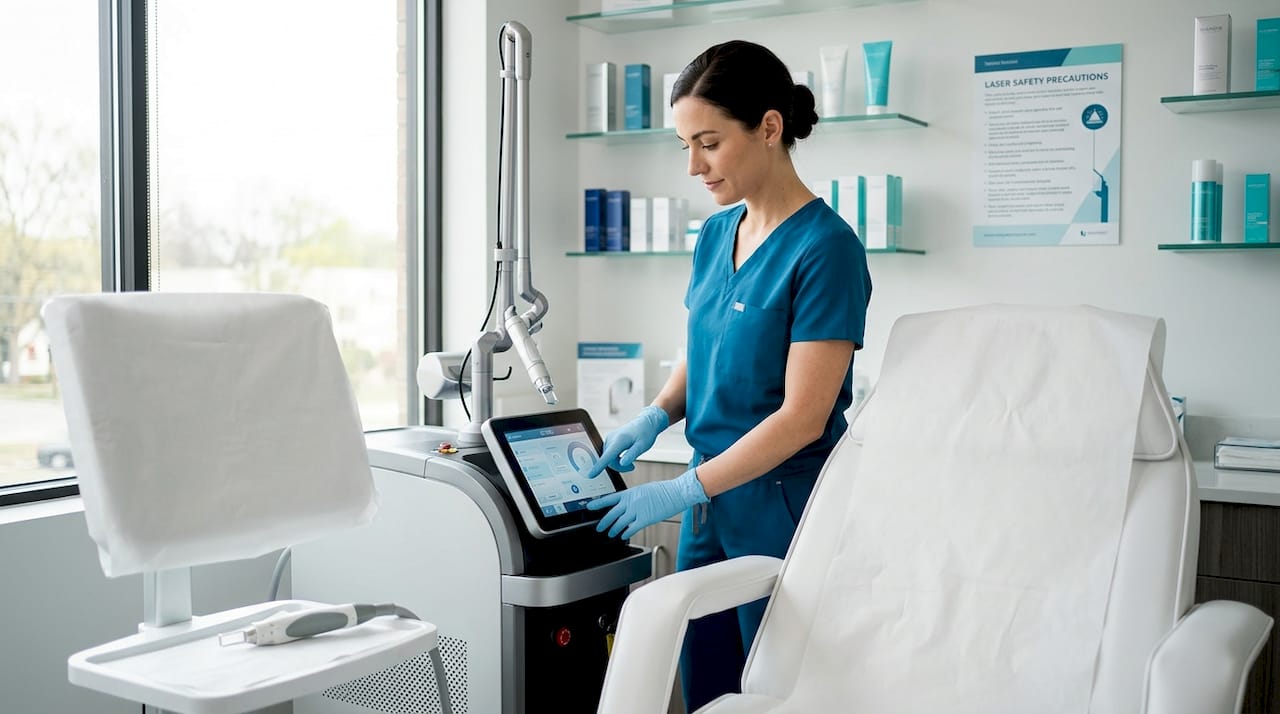
Complications from IPL treatments reported to the FDA include burns, blisters, scarring, and discoloration. A primary contributing factor in many of these cases was failure to follow device operation and maintenance instructions. Improper calibration and inadequate cleaning were identified as probable root causes. These are not rare, catastrophic failures. They are preventable problems rooted in skipped protocols.
Risk factor | What it means for you | What to ask |
Improper calibration | Device delivers wrong energy level | “When was this device last calibrated?” |
Inadequate cleaning | Cross-contamination between clients | “What is your sterilization protocol?” |
Untrained technician | Wrong settings for your skin type | “What training does my provider have for this device?” |
Outdated equipment | Inconsistent energy delivery | “How old is this device and when was it last serviced?” |
No emergency plan | Delayed response to complications | “What happens if I have an adverse reaction?” |
The FDA has also issued safety communications about RF microneedling, warning of serious complications including burns, scarring, fat loss, disfigurement, and nerve damage. These are not minor side effects. The FDA urges clinicians to treat RF microneedling as a medical procedure requiring appropriate oversight and training, not a cosmetic service that any technician can perform after a brief tutorial.
What this means for you as a client: Do not assume that “non-surgical” equals “low risk.” Energy-based treatments require the same level of provider competence and facility diligence as more invasive procedures.
Pro Tip: Ask your provider to walk you through the device they will use, including its FDA clearance status and the specific settings they plan to use for your skin type. A confident, knowledgeable answer is a strong indicator of proper training.
For treatments like BB Glow, which use microneedling to infuse skin-toning serums, the device settings and serum compatibility with your skin type matter enormously. A thorough consultation before treatment is not a formality; it is a safety measure.
Key statistic: The FDA’s MedWatch database receives thousands of adverse event reports related to aesthetic devices annually. Many of these reports involve situations where established protocols were not followed, reinforcing that device safety is as much about human behavior as it is about technology.
Facility safety: Infection control, emergency plans, and compliance essentials
Beyond the credentials of individual providers, the facility itself plays a critical role in your safety. A well-run medical spa operates with the same rigor as any medical practice, and that means structured policies for infection control, emergency response, and regulatory compliance.
Legal and compliance guidance for medical spas describes the value of a patient safety plan that includes standardized operating procedures, an emergency response plan, comprehensive patient assessment, informed consent processes, medical records management, and complication-management policies. Facilities are also expected to meet OSHA workplace safety standards and HIPAA privacy obligations, which protect both staff and clients.
Here is what a compliant, safety-focused facility should have in place:
Written infection control protocols covering sterilization, single-use equipment, and surface disinfection between clients
An emergency response plan that includes access to emergency medications (such as epinephrine for allergic reactions) and a clear protocol for calling emergency services
HIPAA-compliant medical records that document your health history, consent forms, and treatment notes
OSHA compliance for handling biohazardous materials and maintaining a safe workplace
Complication management policies that outline how adverse events are documented, reported, and followed up
Compliance area | What it protects | Red flag if missing |
Infection control | Prevents cross-contamination | Reused needles, unclean surfaces |
Emergency response plan | Enables fast action during adverse events | No trained staff for emergencies |
HIPAA compliance | Protects your private health information | Casual handling of patient records |
OSHA standards | Protects staff and clients from workplace hazards | No visible safety protocols posted |
Informed consent process | Ensures you understand risks before treatment | Rushed or verbal-only consent |
When you visit a facility, look for visible indicators of compliance. Are treatment rooms clean and organized? Are single-use items opened in front of you? Is there a posted emergency procedure? These details tell you a great deal about how seriously a facility takes its responsibility to your safety.
How to verify safety standards before your appointment
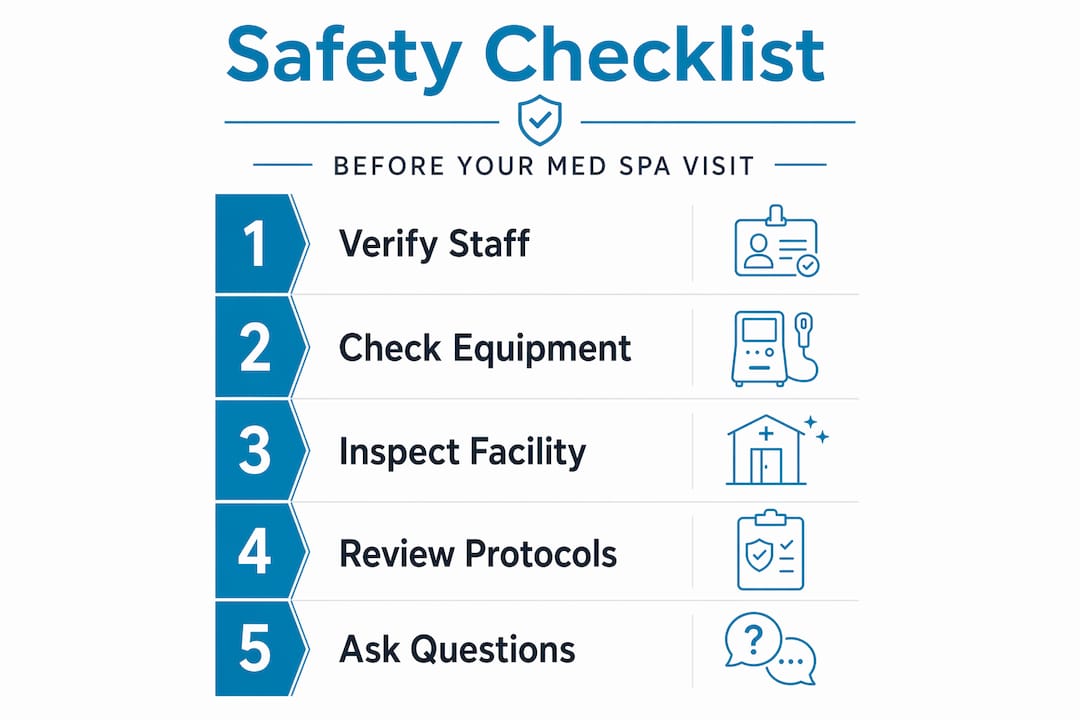
Knowing what good safety looks like is only useful if you act on that knowledge. Here is a practical checklist you can use before booking any medical spa treatment.
The AMA’s patient-safety approach recommends verifying who owns and operates the med spa, who will perform your procedure, whether the supervising physician model matches state requirements, and whether there is an emergency-response pathway for complications. These are the right questions, and you should not feel awkward asking them.
Ask about the medical director. Who is the supervising physician? Are they on site during treatments or available remotely? What is their specialty?
Confirm your provider’s credentials. Who specifically will perform your procedure? What training and certifications do they hold for that service?
Request to see infection control and emergency protocols. A reputable facility will not hesitate to share this information.
Verify documentation practices. Will your medical history and consent form be documented in a secure record? Will you receive a copy?
Ask about equipment maintenance. When was the device last calibrated and serviced? Who performs that maintenance?
Pro Tip: Review treatment packages and service descriptions before your consultation. Facilities that are transparent about what each treatment involves and who performs it are signaling a commitment to informed, safe care.
If you are considering a specific treatment like plasma fibroblast, research the procedure independently before your consultation. Walk in knowing the basics so you can evaluate whether the provider’s explanation is accurate and thorough. When you are ready to move forward, book online with a provider who has answered your questions confidently and completely.
A fresh perspective: Why consistent enforcement and patient vigilance matter most
Here is something most safety guides will not tell you directly: a beautifully written safety policy on a website does not guarantee that the policy is actually followed inside the treatment room. The gap between written standards and real-world enforcement is where most complications occur, and it is a gap that patient vigilance can help close.
Industry compliance resources acknowledge that med spa patient safety and legal compliance have never been more important, while also noting that oversight varies significantly by state. Some states conduct regular inspections and enforce violations aggressively. Others rely almost entirely on complaint-driven enforcement, meaning problems go undetected until a client is harmed.
This creates a situation where two facilities with identical written policies can operate very differently in practice. The one with strong internal culture, regular staff training, and leadership that genuinely prioritizes safety will consistently outperform the one that treats compliance as a paperwork exercise.
What does this mean for you? It means your instincts and questions matter as much as any certification on the wall. Clients who ask specific, informed questions before treatment are less likely to experience complications. Not because asking questions magically improves safety, but because facilities that welcome those questions tend to be the ones that have genuinely earned the right to answer them.
We believe that transparency is the most reliable indicator of safety. When a provider explains your treatment in plain language, answers your questions without defensiveness, and documents everything properly, that is a facility operating with integrity. That is the standard worth seeking out, and it is the standard we hold ourselves to. Review package details and reach out with any questions before your first visit.
Explore safe, effective medical spa treatments with confidence
You now have the knowledge to walk into any medical spa consultation and ask the right questions. That knowledge is genuinely powerful, and it should make the experience of choosing a provider feel less intimidating and more empowering.
At Lux Veritae Skin Spa, we believe every client deserves full transparency about who is performing their treatment, what protocols are in place, and how their safety is protected at every step. Whether you are exploring our BB Glow procedure for a luminous, even complexion, considering scar camouflage options to restore confidence in your skin, or ready to compare treatment packages to find the right fit for your goals, we are here to answer every question with honesty and expertise. Your safety is not a selling point. It is our baseline.
Frequently asked questions
How can I tell if a med spa is following proper safety protocols?
Ask to see infection control procedures, verify staff credentials directly, and confirm that physician oversight meets your state’s requirements. A trustworthy facility will provide this information without hesitation.
Who is allowed to perform energy-based treatments in medical spas?
Physicians or properly trained, supervised non-physicians can perform these treatments depending on state law and device type. In some states, certain devices must be operated by or under the direct supervision of a licensed physician.
Are all med spas required to have a physician on site?
No. Requirements vary significantly by state, and state-level variability means some states allow remote physician oversight while others require on-site presence. Always verify your specific state’s rules before your appointment.
What questions should I ask before getting a cosmetic procedure at a med spa?
Ask who will perform your procedure, how adverse events are handled, whether there is a written safety plan, and what specific training your provider has. The AMA’s med spa safety approach recommends verifying all of these details before consenting to any treatment.
Recommended
Comments