


Male Skin Aging Process Explained for Men 30–60

Male skin aging is defined as the progressive, biologically driven decline in skin structure and function caused by both intrinsic cellular changes and external environmental damage. The male skin aging process explained in clinical terms involves collagen loss, elastin breakdown, and reduced hydration, all of which follow predictable patterns unique to male biology. Men’s skin is 20–25% thicker than female skin and produces roughly twice as much sebum. That structural advantage delays some visible signs, but it does not stop the process. Collagen degrades at approximately 1% per year after age 30, and without consistent intervention, the effects compound quickly.
What biological changes cause the male skin aging process?
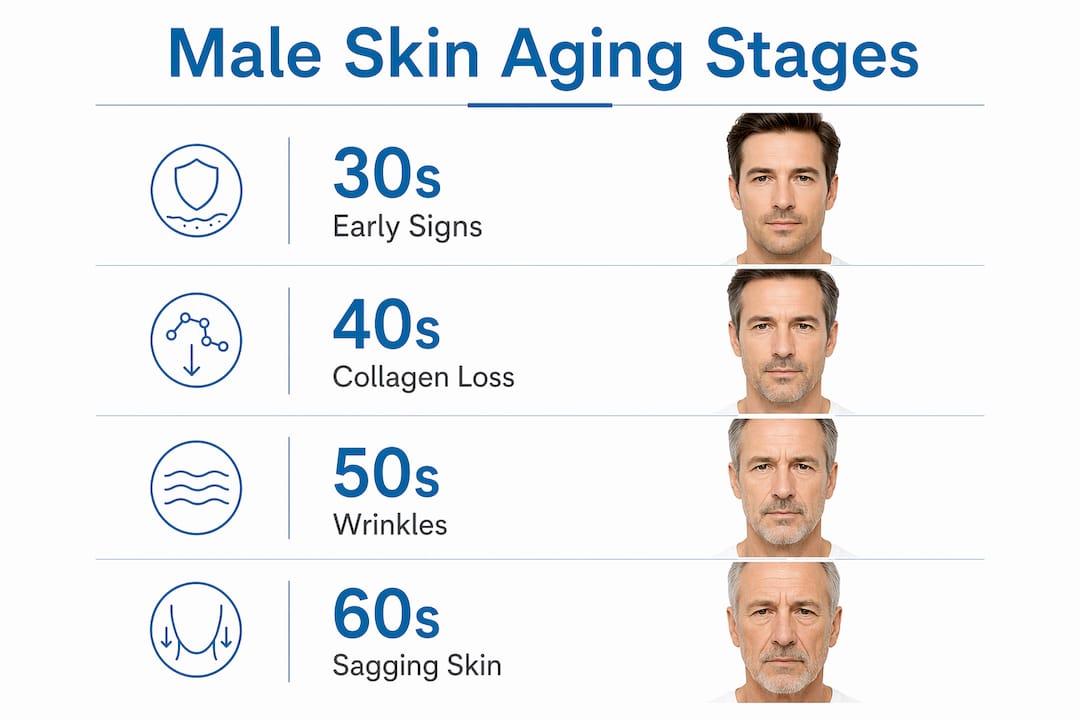
Intrinsic aging in men starts at the cellular level and works outward. The two main drivers are collagen degradation and elastin loss, and both accelerate with age in ways that directly reshape the face.
Collagen is the structural protein that keeps skin firm and plump. Enzymes called matrix metalloproteinases, specifically MMP-1, break collagen down when triggered by UV exposure and chronic low-grade inflammation. As collagen thins, skin loses its ability to spring back after movement. Elastin, the protein responsible for skin flexibility, declines alongside collagen. The result is skin that creases more easily and holds those creases longer.

Skin aging also results from intrinsic factors like mitochondrial dysfunction and genomic instability. These cellular failures reduce the skin’s ability to repair itself after daily stress. Cell turnover slows, meaning dead skin cells linger on the surface longer and the skin appears dull and uneven.
Testosterone plays a double role in male skin aging. It drives higher sebum production through the sebaceous glands, which offers some protection against dryness early in life. But as testosterone levels decline after 40, sebum production drops, and skin that once seemed oily can become noticeably drier and thinner.
Visible aging in men follows a predictable structural pattern caused by muscle contractions and fat pad shrinkage beneath the skin. Forehead lines develop from repeated frontalis muscle tension. Under-eye hollowing comes from the suborbicularis oculi fat pad shrinking over time. Crow’s feet form where the orbicularis oculi muscle contracts with every smile and squint. Understanding this map matters because it tells you exactly where to focus treatment.
Key biological changes to know:
Collagen loss at roughly 1% per year after 30
Elastin breakdown causing reduced skin rebound
Slower epidermal cell turnover leading to dull texture
Declining testosterone reducing natural sebum protection after 40
Fat pad shrinkage creating hollowing under the eyes and along the cheeks
Pro Tip: If you notice forehead lines deepening before crow’s feet, that is the frontalis muscle at work. Targeted treatments like microneedling or peptide serums applied to the forehead specifically will deliver better results than a general approach.
How do external factors accelerate skin aging in men?
Extrinsic aging is where men often lose their biological advantage fast. UV exposure accounts for up to 80% of visible skin aging by generating reactive oxygen species that trigger MMP-1 and break down collagen. UVA light penetrates deep into the dermis, damaging collagen synthesis pathways even on cloudy days. Men are statistically less consistent with sunscreen use than women, which means the 15-year appearance advantage that male collagen density provides gets erased faster than it should.
The concept of the “exposome” captures all the external factors that collectively age the skin. It includes UV radiation, air pollution, tobacco smoke, diet, sleep quality, and even grooming habits. Each factor adds oxidative stress. Together, they overwhelm the skin’s natural antioxidant defenses.
UV radiation. The single largest extrinsic aging factor. Daily UVA exposure, even without sunburn, degrades collagen and inhibits new synthesis.
Air pollution. Particulate matter and ozone generate free radicals that damage the skin barrier and increase inflammation.
Tobacco smoke. Smoking reduces blood flow to the skin, depletes vitamin C, and accelerates collagen breakdown. Smokers show deeper wrinkles and a grayish skin tone earlier than non-smokers.
Poor diet and dehydration. A diet low in antioxidants and high in refined sugars accelerates glycation, a process where sugar molecules attach to collagen and make it stiff and brittle.
Shaving. Daily shaving removes part of the skin’s protective outer layer, creating a cycle of barrier disruption and recovery. Over time, chronic shaving trauma increases sensitivity and dryness if not managed with the right products.
The compounding effect of these factors is significant. A man who smokes, skips sunscreen, and shaves daily without barrier repair is accelerating collagen loss from multiple directions at once. Addressing even two of these factors produces measurable improvement in skin condition within months.
What is an effective anti-aging skincare routine for men aged 30–60?
A consistent, simple routine outperforms a complex one that gets abandoned. A 3-step regimen maintained daily shows more effectiveness than irregular multi-step routines. The foundation is a gentle cleanser, a moisturizer, and a broad-spectrum SPF 30+ sunscreen applied every morning without exception.
Male skin tolerates stronger active ingredients better than female skin due to its thickness, but it still requires formulations designed for deeper penetration and its specific lipid profile. Generic products formulated for thinner skin may sit on the surface without delivering active ingredients where they are needed.
The core routine
Cleanser: Use a gentle, pH-balanced cleanser morning and night. Avoid foaming cleansers with sulfates if you shave daily, as they strip the barrier further.
Moisturizer: Choose a formula with ceramides and niacinamide. Ceramides rebuild the skin barrier. Niacinamide reduces redness, controls oil, and supports collagen production.
SPF 30+: Apply every morning, rain or shine. Reapply if you spend more than two hours outdoors.
Adding active ingredients
Retinol and vitamin C are the two most evidence-backed anti-aging actives available without a prescription. Retinol usage should start at 0.025–0.25% concentration, applied 2–3 nights per week, with gradual buildup over 8–12 weeks to minimize dryness and irritation. Vitamin C at 10–15% L-ascorbic acid applied in the morning neutralizes free radicals and supports collagen synthesis. Introduce each ingredient separately, not simultaneously, so your skin can adjust.
Ingredient | Benefit | Starting frequency |
Retinol (0.025–0.25%) | Boosts cell turnover, reduces wrinkles | 2–3 nights per week |
Vitamin C (10–15%) | Antioxidant protection, collagen support | Every morning |
Niacinamide | Barrier repair, oil control, redness reduction | Daily, morning or night |
Ceramides | Restores skin barrier, locks in hydration | Daily moisturizer |
Peptides | Signals collagen production, firms skin | Daily serum |
Pro Tip: Layer products from thinnest to thickest consistency. Apply vitamin C serum after cleansing, let it absorb for 60 seconds, then apply moisturizer, then SPF. Never mix retinol and vitamin C in the same application.
You can read more about building a routine for your skin type to tailor these steps to your specific needs.
What clinical treatments and lifestyle changes help men maintain youthful skin?
Topical products slow the aging process. Professional treatments can reverse visible damage that has already occurred. The two approaches work best together.
Professional treatment options for men:
Microneedling: Creates controlled micro-injuries that stimulate collagen production. Particularly effective for forehead lines, under-eye hollowing, and overall skin texture. Male skin responds well due to its thickness and higher collagen density.
Chemical peels: Remove damaged outer skin layers to reveal fresher skin beneath. Superficial peels work well for uneven tone and early fine lines. Medium-depth peels address deeper wrinkles and sun damage.
Non-surgical treatments: Options like radiofrequency and ultrasound-based therapies tighten skin without downtime. These are well-suited for men who want results without visible recovery periods.
For men concerned specifically with under-eye hollowing and darkening, targeted paramedical rejuvenation treatments address both the structural fat loss and pigmentation changes that make the eye area look aged.
Lifestyle strategies that directly affect skin aging:
Quit smoking. The improvement in skin color and texture begins within weeks of stopping.
Eat antioxidant-rich foods. Antioxidant defense through diet and topical skincare is vital to counteract oxidative stress from environmental and systemic aging factors. Focus on foods high in vitamins C and E, zinc, and omega-3 fatty acids.
Drink enough water. Dehydration makes fine lines more visible and slows cell turnover.
Manage shaving trauma. Use a sharp single blade, shave with the grain, and apply a barrier-repairing balm immediately after.
Reassess your routine every 6 months. Skin needs change as you age, and a routine that worked at 35 may need adjustment at 45.
Lifestyle factor | Effect on skin | Recommended action |
Sun exposure | Accelerates collagen breakdown | SPF 30+ daily, reapply outdoors |
Smoking | Reduces blood flow, depletes vitamin C | Cessation improves skin within weeks |
Diet | Glycation stiffens collagen | Increase antioxidant-rich foods |
Shaving | Disrupts skin barrier daily | Use barrier-repair balm post-shave |
Hydration | Dehydration amplifies fine lines | Drink consistently throughout the day |
Understanding non-surgical skin treatment options can help you decide which professional approach fits your skin goals and schedule.
Key takeaways
Male skin aging is a predictable biological process that responds directly to consistent sun protection, evidence-based active ingredients, and targeted professional treatments.
Point | Details |
Collagen loss drives visible aging | Skin loses roughly 1% of collagen per year after 30, causing wrinkles and hollowing. |
UV is the top external cause | Up to 80% of visible aging comes from UV exposure, making daily SPF non-negotiable. |
Simple routines outperform complex ones | A consistent 3-step regimen beats an irregular multi-step routine every time. |
Active ingredients need gradual introduction | Start retinol at 0.025–0.25% and vitamin C at 10–15%, building up over 8–12 weeks. |
Professional treatments reverse existing damage | Microneedling and chemical peels stimulate collagen and address damage topical products cannot. |
What I’ve learned after years of working with men’s aging skin
Most men who come to me have the same story. They ignored their skin for 20 years, noticed something shift around 40, and then tried to fix a decade of damage in a month. That urgency is understandable. The biology is not on your side once collagen loss compounds. But the good news is that male skin responds well to intervention at any age, often faster than people expect.
The biggest misconception I see is that skincare is complicated or that it requires a cabinet full of products. It does not. A cleanser, a moisturizer, and an SPF will do more for your skin over five years than any single treatment. Add retinol at night when you are ready. That is the whole foundation.
What I have also noticed is that men underestimate lifestyle. The client who quits smoking and starts eating better sees skin changes that no serum can replicate. Topical products work on the surface. Lifestyle works from the inside out. You need both.
My honest advice: start with the basics, stay consistent for 90 days, and then reassess. Do not change everything at once. Skin responds to consistency, not complexity. And if you want to address specific concerns like under-eye hollowing or deep forehead lines, a professional consultation will get you to results faster than experimenting alone.
— Lux
Personalized skin aging care at Luxveritae
Luxveritae specializes in treatments designed specifically for the structural changes that come with male skin aging. From targeted under-eye rejuvenation that addresses both hollowing and pigmentation, to customized facial treatments that work with your skin’s natural biology, every service is built around your individual skin type and goals. The team at Luxveritae combines paramedical expertise with a personalized approach so results look natural, not treated. If you are ready to take a concrete step toward healthier, younger-looking skin, book your consultation and get a treatment plan built around where your skin actually is right now.
FAQ
What are the first signs of aging in men’s skin?
The first signs typically appear as forehead lines from frontalis muscle tension and early crow’s feet from repeated eye movement. Under-eye hollowing from fat pad loss often becomes noticeable in the late 30s.
How does male skin age differently than female skin?
Male skin is 20–25% thicker and produces more sebum, which delays some visible aging. However, men typically use less sun protection, which accelerates collagen breakdown and can erase that biological advantage within a decade.
When should men start an anti-aging skincare routine?
The best time to start is your 30s, before significant collagen loss accumulates. A basic routine of cleanser, moisturizer, and SPF 30+ started early prevents damage that is far harder to reverse later.
Does shaving affect how fast men’s skin ages?
Yes. Daily shaving disrupts the skin barrier, increasing inflammation and dryness over time. Using a sharp blade, shaving with the grain, and applying a barrier-repair balm after each shave minimizes long-term damage.
What is the most effective professional treatment for aging male skin?
Microneedling is one of the most effective options for men because it stimulates collagen production in the deeper dermis where male skin aging is most active. Chemical peels address surface damage and uneven tone effectively as a complement.
Recommended
Comments